Printing Small, Performing Big
How Additive Manufacturing Enables Foldable, High-Efficiency Designs
Wednesday 28th January 2026
One of the biggest limitations in traditional manufacturing is size.
If a part is large, it usually has to be manufactured large. That affects everything downstream, machine capacity, tooling cost, assembly time, transport, and storage. Even in many 3D printing processes, part size often dictates how many components are needed and how much post-assembly is required.
Additive Manufacturing changes that.
With the right design approach, parts can be printed in a compact state, efficiently packed into a print build chamber, and then expanded, unfolded, or deployed into a much larger functional footprint after printing.
The Challenge: A Foldable Drone
As the Defence and Robotics industries continue to demand lighter, faster, and more adaptable platforms and autonomous systems, Additive Manufacturing is increasingly being used not just for prototyping, but for functional, design-led solutions and end production.
In this project, we design and 3D print a
foldable drone
that can be
produced in a compact form, then expanded post-print
. The result is a drone body that prints smaller, packs more efficiently in the build chamber, and assembles easily and quickly into a larger functional structure without extra fasteners or separate hardware or separate stages of labour or additional process requirements.
Balancing Size, Throughput, and Assembly
Traditional drone bodies are typically manufactured and/or 3D printed, in multiple rigid sections and assembled in post-production phases, or manufactured as a single large body, often being more costly to produce.
Both approaches introduce compromises, either in cost, time, or design freedom.
For this project, the goal was different:
This is where Additive Manufacturing, and specifically SLS (Selective Laser Sintering) enables a fundamentally different solution.
Printing Compact: A Design Approach Enabled by AM
Rather than designing the drone at its final size and working backwards, we approached the problem differently:
What if the drone didn’t need to be its final size when it was printed?
By designing the body with integrated, print-in-place hinges, the drone can be manufactured in a folded, compact configuration, allowing wings and additional sections to fold neatly for printing. After printing and cleaning, the structure unfolds into its full working form - without additional bolts, fasteners, or secondary components.
- Larger functional designs to fit within a fixed build volume
- More complete assemblies per print
- Lower cost per unit
- Faster transition from test part to small-batch production
Crucially, this type of design is only practical because of Additive Manufacturing.
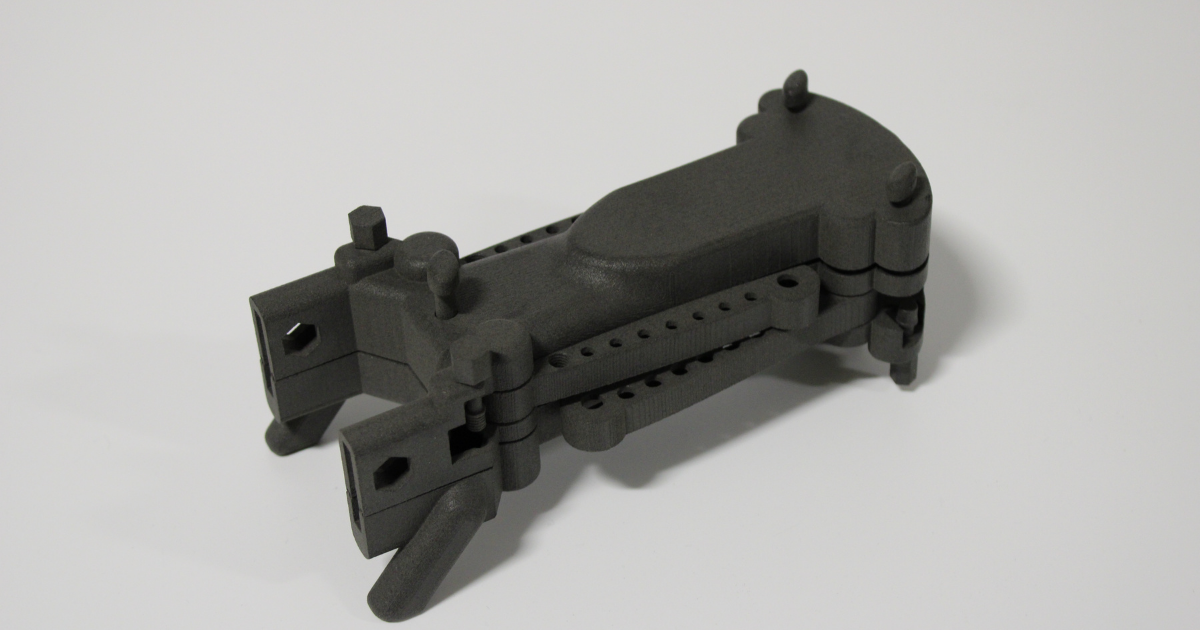
Above: Drone folded in compact print state
Right: Drone expanded to full capacity
AM Technology & Material Selection
The drone was printed using the Formlabs Fuse 1+ 30W in Nylon 12.
Using SLS technology gives more freedom of design, removing the need to print support structures, and increasing the opportunity to print assemblies, mechanisms and print-in-place components.
Nylon 12 was chosen for its balance of strength and durability. It has excellent mechanical performance, is a UV-stable and repeatable material.
This particular foldable drone was designed for surveillance use, rather than harsh weather deployment, making Nylon 12 a well-suited choice.
Build Efficiency: Turning Design into Throughput
Designing the drone to print in a compact state directly impacts production efficiency. By folding the geometry for printing:
If the drone were printed at its final, expanded size, it would either not fit within the build chamber at all, or need to be split into multiple sub-assemblies, increasing cost and complexity
Print & Cost Overview:
- Drones per build: 8
- Material: Nylon 12
- Material per drone: 0.13 kg
- Part cost per drone: £11.07
- Full build time (8 drones): 12h 31m
Once the design was validated, moving from single units to short-run production becomes a simple scaling exercise, without tooling changes or rework.
Design & Production Considerations
Design for Additive Manufacturing doesn’t stop at geometry alone. Reliable results depend on understanding how parts behave during printing and post-processing.
Key considerations from this project include:
- Consistent orientation:
Both halves of the drone must be oriented identically in the build, ideally printed on their side
- Hinge clearance:
The lower section must be printed in an open position — otherwise the hinge axis can fuse
- Post-processing:
Thorough powder removal is essential due to multiple moving components
This is where applications engineering experience plays a critical role - turning a clever concept into a repeatable, functional part.
Beyond Defence: Applying the Same Thinking Elsewhere
While this project was developed with defence and surveillance in mind, the principles extend far wider.
The same approach could be applied to:
- Robotics and autonomous vehicles
- Deployable sensor housings
- Foldable inspection tools
- Compact transport fixtures
- Modular manufacturing equipment
Anywhere that space efficiency, rapid iteration, and reduced assembly matter, Additive Manufacturing enables new ways of thinking about part size and function.
Rethinking What’s Possible with Additive Manufacturing
Projects like this often begin with a simple shift in mindset: Designing for how a part is printed, not just how it’s used.
Additive Manufacturing allows engineers to:
- Test real-world performance quickly
- Refine geometry between builds
- Scale production without tooling
- Print only what’s needed, when it’s needed
This foldable drone demonstrates how AM isn’t just about making parts faster, it’s about making different kinds of parts possible.
Want to explore what this approach could unlock for your application?
Whether you’re working in Defence, Robotics, or Industrial mMnufacturing, our applications engineers can help you rethink part size, assembly, and production using Additive Manufacturing.
👉 Request a
test print or
speak to our engineering team to see what SLS can enable in your own designs.