Show Keyboard Shortcuts

3D Printers In-House Benefits of Owning Your Own AM Capability.

Benefits of Owning 3D Printers In-House

Additive Manufacturing (AM) is an essential problem-solving and manufacturing tool across Engineering, Manufacturing, Industrial Design, Automation, Robotics, Aerospace, Defence, Automotive, Sub-Sea & Marine, and more!

One of the biggest decisions teams face is whether to outsource printing or bring it in-house. Here we outline the core benefits of owning 3D printers internally, from cost and speed advantages to flexibility, IP protection, sustainability and growing AM capability across your organisation.

When Does In-House AM Make the Most Sense?

You’ll benefit most if you:

  • Produce fixtures, brackets, jigs or tooling regularly
  • Need fast prototyping to accelerate development
  • Carry high levels of spare part stock
  • Suffer delays from external suppliers
  • Work in sectors with sensitive IP
  • Want to reduce costs and increase operational resilience
  • Are scaling robotics, automation or continuous-improvement projects
  • Are project based or contract manufacturing

If you’re unsure, our Applications Engineers can help you evaluate the right setup based on your parts, materials and volumes.
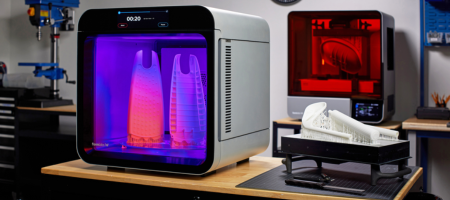
3D printers in a workshop

Augment your automation

Contact our team for further information, advice, test prints and quotes

Contact Us

Ready to Take your First Steps?

If you are ready to explore AM, our engineers are here to help you evaluate options. Together we can explore your applications, suitable materials and AM technologies. Just complete the short form below and we'll be in touch.

Prefer to chat? Call our team on 0800 689 1011, option 1.


Why have Additive Manufacturing In-House

1. Lower Costs

Owning industrial 3D printers provides the lowest long-term part cost compared with outsourcing or traditional manufacturing. In-house AM pays back quickly, especially when producing prototypes, tooling, fixtures, workholding, replacement components or low-volume/ high-value end-use parts. A typical ROI (return on investment) is 3 to 9 months.

  • Print functional parts for a fraction of outsourced prices
  • Predictable, project-based running costs
  • No Minimum Order Quantities (MOQ): print 1 or 1000 parts
  • No need for costly tooling or set-up charges
  • Easily scale printers as required for production & project demands
  • Assign OpEx budget through flexible finance options

2. Fast Turnaround: Parts in Your Hands in Hours

Speed is one of the biggest advantages of owning a printer. With in-house AM you have complete control of your schedule, no more waiting for a purchase order to be approved, waiting for a supplier to respond, waiting for a missing part or waiting for the courier to arrive.

  • Produce same-day prototypes
  • Run overnight builds for tooling and end-use parts
  • React instantly to breakdowns or design changes
  • Create variants or iterations at no extra cost
  • Eliminate delays from suppliers and logistics

3. Alleviate Resource Pressures

Let the printer do the work. A 3D printer effectively becomes a digital worker to alleviate resource pressures. Your team focuses on higher-value engineering while the machine handles production.

  • Operates unattended even overnight or at weekends
  • Increases capacity without increasing headcount
  • Frees engineers from repetitive, low-value tasks
  • Reduces dependency on busy tool rooms or outsourced suppliers

4. Gain Independence from External Supply Chains

In-house AM reduces your reliance on external vendors or directly at immediate risk to global political, economic or social volatilities. This is especially valuable for robotics, automation, packaging lines and maintenance-heavy environments.

  • Guaranteed access to critical components
  • No long lead times or supplier delays
  • No minimum orders
  • Reduced downtime risk

5. Reduce Stock Holding and Costs

By 3D printing parts on demand, at the point of need, in-house AM supports lean, efficient operations which reduces physical spare inventory by 30–70%. Reduce costs and space for warehousing and storage, reduce rent and energy bills, or use the newly freed-up space to develop a 3D printer centre!

Printing on demand also means that parts can be updated, redesigned or edited before printing, so only the latest versions are produced.

  • Replace racks of spare parts with digital inventories
  • Print only what you need, when you need it
  • Reduce storage space and carrying costs
  • Eliminate obsolete or unused stock
Industrial 3D printer with printed parts

Supplementary Benefits of AM

Alongside the clear operational gains, owning AM also strengthens your organisation. It develops internal capability, drives more sustainable ways of working, and empowers teams to innovate and grow.

Build Internal Knowledge and AM Expertise - Teams who own printers learn by doing, which expands AM use across the business from R&D and product development through to production lines and maintenance. The more the technology is used, the more opportunities are identified, so AM becomes a strategic advantage.

Protect and Retain Your IP – 3D printing in-house enables secure innovation without compromise by maintaining confidentiality. There’s no need to share CAD files externally and you can restrict or control access by role, department or site to your AM equipment; only sharing what should be shared. This is particularly important for multi-site manufacturers and those operating in sensitive industries such as Defence, Nuclear and Aerospace.

Attract and Retain Talent - Modern engineering teams expect access to modern tools. Businesses with in-house 3D printers often see higher job satisfaction and a stronger innovation culture by enabling greater creativity and lowering the risk of failure by giving freedom to design, test and print at low cost. Having AM in-house also encourages continuous improvement, cross departments.

Become More Sustainable - In-house AM supports wider sustainability goals by reducing old or un-used stock, reducing freight and logistic emissions and reducing material wastage.


Ready to Explore In-House 3D Printing?

Whether you’re evaluating ROI, comparing technologies, choosing your first printer, or adding your 10th printer, we’re here to help.